Medicinal Herbs
The ancient apothecaries, shamans, and albuaryo’s discovered medicinal herbs that aided in treatment of patients.
Countless medicinal herbs were originated from the valleys of the Nile; Tigris and Euphrates; yellow and Yangtze; and Indus rivers.
Western and Traditional Systems of Medicine
Western Medicine was a system the term for medicinal practice that originated from Europe.
Traditional systems of medicines comprise of:
- Ayurvedic
- Siddha
- originated in India Unani (Greco-Arabic Medical System)
- iV
- originated from West Asian Greeks
In ancient times, the term pharmakon came, which meant magic spell, remedy, or poison. ( origin for the word of Drugs or Pharmacy )
Ancient Era
Antiquity
The era of antiquiy was the time beginning up to 1600 AD.
In this era, early man used the materials in his surroundins such as: leaves, mud, dirt, and cool water, to treat conditions such as wounds and bleeding. Cool water was our original soothing application for healing.
In antiquity, drug practicioners and pharmacists were instead: Tribal Healers, who aimed at maintaining health through medicinal knowledge. They were called Shamans in the East.
Ancient Sumerian, Babylon, and Assyrian Medicine
In ancient Babylon, medical care was undertaken by two practicioners: the Asipu and Asu.
- Asipu
- the magical healer; practitioners who performed spells an incantations.
- Asu
- the empirical healers; practitioners who used a large collection of drugs and herbs; prominent drugs of the time were laxatives and enemas.
The earliest known record of the practice of the art of the apothecary was during ancient Babylonia, the jewel of ancient Mesopotamia.
In Babylon, known as the cradle of civilization, the practicioners o healing were priests, pharmacists, and physicians ( Bender and Thorn, 1965 ).
In ancient Babylonia, the first symptoms of illnesses, prescriptions, and directions or compounding, and invocation to the gods were recorded on clay tablets.
The Sumerians has a well-ordered civilization in Babylon soon after 5000 BC. Health was an important subject in their culture which came with their common saying of:
“I have brought health to the land”
12000 tablet fragments of Assyrian and Babylonian origin are in the British Museum and 660 of them are said to be of medical interest.
Medical care in ancient Babylon involved a tight knit relationship between empirical medicine and spiritual medicine.
Physicians in ancient Babylon called upon the aid of magicians in treatments and vice versa.
Most of their medicinal magics were disgusting and unpleasing in the belief that it would drive away evil spirits.
Ancient Chinese Medicine
Ancient Chinese medicine, specifically pharmacy stems from Shen Nung around 2000 BC.
Over the millennia, the Chinese have used themselves as guinea pigs for their medicinal herbs; they tested various plants and recorder their effects and properties of inducing cold, heat, warmth, and coolness and classified the medicinal effects of the plants on various parts of the body and then tested further to determine the toxicity, lethal dosage, and etc.
In Chinese pharmaceuticals:
- The stem of the Chinese ephedra ( Ephedra sinica ) is a sudorific ( caused increased perspiration ).
- The roots of Chinese ephedra ( Ephedra sinica ) can reduce perspiration.
- Cassia bark ( Cinnamomum cassia ) is warming in nature, and is useful in treating colds.
- Mint is cooling in nature, and is used to relieve the symptoms of illness resulting from heat factors.
Shen Nung
Shen Nung was an emperor who sought out and investigated the medicinal properties of hundreds of herbs. He was calledd the Father of Chinese Pharmaceutics and the Chinese Father of Agriculture.
He is reputed to have tested many of his drugs on himself, which led to him writing the first Pen T-Sao, which is a book on roots and grasses; which contained 365 herbal drugs, 11000 Rx handed down through oral tradition and compiled by Shen Nung.
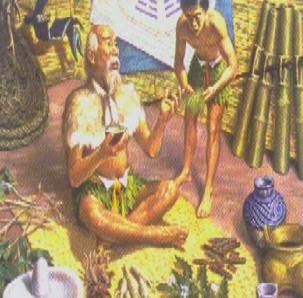
Shen Nung and his apprentice with the “Pa Kua” (Bagua) behind them, a mathematical design symbolizing creation and life.
Ancient Egyptian Medicine
Ancient Egypt is known for having the most important pharmaceutical record, the Papyrus Ebers ( 1500 BC ) named after Georg Ebers.
The Papyrus Ebers was a collection of more than 800 ancient remedies and 700 drug preparations of recorded Egyptian gargles, suppositories, inhalations, poultices, lotion, and ointments.
At around 2600 BC, ancient man began to use clay tablets were used in documenting healing practices.
Scribes usually wrote on papyrus brushes dipped in ink. The ancient Egyptians made ink through mixing ground brightly colored mineral powder with a liquid.
Papyrus was also a food source and used as material for rope, sandals, window shades, toys, amulets, and even small fishing boats.
Ancient Egyptian Pharmacy were conducted by two or more echelons:
- Rhizotomes
- the gatherers and preparers of drugs.
- Pharmacopoles
- The chiefs of fabrication and head pharmacists.
Ancient Egyptian Pharmacy used rudimentary tools such as:
- mortars
- pestles
- hand mills
- sieves
- weighing scales.
There are mentions of ancient Egyptian pharmacy in biblical records dating as far back as 1200 BC:
- Book of Sirach
- mentions creation of medicines by God.
- Genesis
- mentions myrrh as astringent, carminative, and protectant.
- Exodus
- mentions olibanum (frankincense).
Egyptian Gods and Apothecaries
Egyptian physicians were men of high position and reputation; Egyptian medicine was a very respected field and yet is was never separated from religious belief for many Egyptian physicians were believers of the many gods of Egypt.
The mummification process of the Egyptians done as for their particular belief in the afterlife gave us many well preserved human specimens for us to observe. Scientists observed that ancient Egyptians usually suffered from cranial, spinal, long bone, and dental conditions; arthritis was also a common ailment among the Egyptians.
Dental diseases were an affliction usually common in the leisure class.
The following are the gods praised by ancient Egyptians and by–– most notably, their physicians:
- Thoth
- The great god of healing; considered to be skilled and all powerful.
- Anepu
- Apothecary of the gods of Egypt; held the position of “keeper of the house of medicines and chamber of embalmment”.
- Ra
- The compounder of drugs; he attempted to mix a cure-all for himself but failed.
- Isis
- A doctor goddess who cured the great Ra and relieved him of “all suffering and evils of any sort”.
Ancient Mediterranean Medicine
As early as ancient times, man realized the importance of a trademark for identification and representation.
In fact, in the Mediterranean, one of the first therapeutic agents to bear a trademark was the Terra Sigillata, a clay tablet originating from the island of Lemnos before 500BC.
Once a year, clay was dug from the Lemnian hillside in the presence of governmental and religious dignitaries; this was followed by the clay being washed, refined, and rolled to an appropriate mass; then formed into pastilles with an official seal by a priestess; then lastly sun dried and distributed.
The Greeks
Around 600 BC, the greeks began to integrate science into mythological thinking; instead of attributing diseases to spiritual causes they used logical thinking to identify the causes of diseases and illnesses.
It is stated by medical historians that ancient Greek medicine was the origin of modern medicine.
Essential Figures in Ancient Greek Medicine
Aesculapius
Aesculapios, also known as Asklepios or Asclepius was active around 420 BC and was a historical character reputed to be the son of Coronis and the Greek god Apollo.
Apollo, his father was the god of medicine, music, and the sun.
Aesculapios was born when his mother was burned in a funeral pyre due to her acts of infidelity against Apollo, with her unborn child, Aesculapios being rescued by having Coronis be cut open and retrieved from his mother’s womb.
His other name, Asklepios means to cut open; referring to his origin as a baby cut open from his mother.
After his birth he was placed under the care of Chiron, a centaur who raised and taught him the ways in the art of medicine.
Aesculapios later married Epione and fathered three sons:
- Machaon
- Podalirus ( Podaleirios )
- Relesphoros
and six daughters:
- Hygeia
- “Hygiene”; the goddess/personification of health, cleanliness, and sanitation; compounder of remedies; apothecary and pharmacist.
- Meditrina
- the serpent bearer
- Panacea
- the goddess of universal remedy
- Aceso
- the goddess of the healing process
- Iaso
- the goddess of recuperation from illness
- Aglaea
- the goddess of the glow of good health
Aesculapian Temples were build in the honor of Aesculepios as places where the art of healing was practiced.
The original Aesclepiadae, physicians and healers who claim to be direct descendants of Aeusculapios, kept the medical secrets and pharmaceutical formulas among family leaders.
These temples were not welcome the unclean and those about to die, despite being a place of healing.
Aesculspios, despite being a demigod, was made into a deified god from the praise and repute he gained from his followers and descendants; he is commonly depicted with a rod that wreathed with a snake, which became the symbol of medicine ( the rod of Aesculapius ). He was associated with the Roman/Etruscan god Vediovis and the Egyptian god Imhotep.
The death of Aesculapios came about in two ways depending on the source material, but both being at the hand of the god Zeus. In one story he was struck down by Zeus for resurrecting Hippolytus in exchange for gold; in another story, Hades asked his brother Zeus to stop Aesculapios from reviving people in fear of Hades not receiving new citizens in the underworld.
Hippocrates of Kos
Hippocrates of Kos was active around 460–357 BC and was deemed the “Father of Medicine”; he was a philosopher, physician, and pharmacist.
He is known for writing the Oath of Hippocrates— now commonly known as the Hippocratic Oath, the most impressive document in medical ethics.
Hippocrates also liberated medicine from the misconception that illnesses stemmed from “bad mythical spirits”.
The adoption of the concepts of the scientific method and the concept of homeostasis in medicine.
According to Hippocrates, diseases were a disturbance in the body’s fluid ( the four humors ), those fluids are the following:
- blood
- phlegm
- yellow bile
- black bile
Hippocrates had many famous contemporaries, notably: Socrates, Plato, and Aristotle.
During Hippocrates time, specifically during the foundation of the City of Alexandria in Egypt by Alexander the Great, ancient Greek medicine thrived and was at its best.
Aristotle
Aristotle is a figure known in numerous fields and was alive from the years 384–322 BC.
In the field of Greek medicine, he introduced the sciences of:
- comparative anatomy
- systemic zoology
- embryology
- botany
- physiology
Aristotle was very opinionated and believed that the dissection of the human body was taboo and claimed that the “inward parts of man are known least of all” because he considered them sacred.
Theophrastus
Theophrastus was a student of Aristotle and Greek philosopher who was alive during 371–287 BC, he advanced the sciences of botany and was deemed the father of Botany.
Theophrastus studies the adverse effects of plants and his observations and writings that dealt with the medical qualities and peculiarities of herbs are accurate even today.
His book, entitle “History of Plants”, included the description of plants and important plant constituents.
Mithridates VI
King Mithridates VI of Pontus was alive around the time of 100 BC; he was a king of Greek and Iranian descent who ruled over the kingdom of Pontus ( now modern day Turkey ). He was called the Royal Toxicologist.
His contribution to medicine was his practice and refinement of the art of poisoning as well as the art of preventing and counteracting poisoning.
King Mithridated VI of Pontus used himself and prisoners as test subjects for poisons and antidotes.
In his studies, he made a formula named Mithridatum, which has alleged panantidotal powers and was known for over a thousand years as an antidote against all kinds of poisons.
Ancient Turkish Medicine
Ancient Turkey was originally Pontus, the kingdom of King Mithridates VI.
Mithridates VI’s famous “Theriaca” contained 54 ingredients and was tested on prisoners with the goal of finding the cure for all poisons.
Mithridates VI’s experiments made him declare that he had discovered an antidote for every venomous reptile and poisonous substance.
His “Theriaca” was made with the Mithridatum as a base alongside new ingredients that Mithridates VI claimed widen the scope of its effects.
Ancient Roman Medicine
The Romans did not have a system of medicine of their own; whatever practices and developments made there that was medically worth while was attributed to the Greeks during the Greco-Roman era.
In ancient Rome, the medicinal practices were rooted heavily in the concepts of religion; every disease to them has a minor deity and medical treatments consisted of satisfying and placating the evil spirits involved.
In Roman culture, the pater pamilia or head of the house was not only the supreme authority of the home but also its very own physician and health officer. The household included the family, slaves, and domestic animals.
The pater pamilia was culturally required to be knowledgeable in the use and application of drugs; which involved administering and observing the rites of mystery and magic.
Medicine in the Middle Ages
Medicine arrived in Rome with the conquest of Greece. To be a doctor in Rome was considered beneath them and something only foreigners would do.
After the conquest of Greece, many poverty stricken Greek physicians and healers sold themselves as slaves to be able to exercise their professions, many of which became famous and became free men.
During this time, the medical and pharmaceutical cultures merged together forming the Greco-Roman era. With the introduction of Greek medicine, the prior religious medical practices of Rome was displaced.
Around 1240 AD, pharmacy and medicine was separated when public pharmacies were established and legalized in Sicily and Southern Italy.
Essential Figures of the Middle Ages
Galen
Galen, also known as Claudius Galen and Pergamese Galen was alive around 130–200 AD and was known as the first pharmacist/botanist as well as the greatest name in medicine after Hippocrates.
“On the Art of Healing”, his most famous writing and was famous for his works in anatomy and physiology.
Galen practice both pharmacy and medicine during his time in Rome. In his practice, he became associated with medicines called galenicals, which referred to medicines made from natural ingredients rather than synthetic ingredients.
He was the originator of the formula for a cold cream, similar to those known today.
Galen’s many procedures in compounding medicine have their own counterparts in modern compounding laboratories and procedures.
He had many other contributions, such as did work on the subject of anatomy from his work on pigs ( “the animal most similar to man” according to Galen ) and monkeys, as well as his introduction of several pharmaceutical drugs such as willow bark and landanum ( an opium tincture ) as anesthetics
King Frederick II
King Frederick II was the ruler of the Kingdom of Two Sicilies. He contributed to the field of pharmacy by allowing the separation of the practice of pharmacy for the first time in Europe ( Edict of 1231 ).
Girolamo Savonarola
Girolamo Savonarola wasa powerful Dominican friar and political leader.
He gave official advice and guidance to the collaboration between the Guild of Apothecaries and Medical Society in conceptualizing the first ever pharmacopeia.
Nuovo Receptario
Nuovo Receptario wrote the first book of legal standards ( pharmacopeia) written in the Italian language in 1498.
Ibn Sina
Ibn Sina, also known as Avicenna, was alive around 980–1037 AD; he was known as “The Persian Galen”.
Ibn Sina was a pharmacist, poet, physician, philospher, and diplomat during the Arabian era.
As a pharmacist and physician, he wrote 200 medical treatises, and was among the brilliant contributors to the sciences of Pharmacy and Medicine during the Arabian era.
His pharmaceutical teachings were accepted as authority in the West until the 17th century; and still are dominant influences in the Orient.
“Canon of Medicine”, his main work, is a comprehensive medical encyclopedia. Two volumes about pharmacy: one on simples and one on compounds, including a cancer compound called hindiba
Contributed to the gilding and silvering of pills to make them easier to swallow
Saints Cosmas and Damian
The Patron Saints of Medicine and Pharmacy. Damian, the apothecary; and Cosmas, the physician.
Twin brothers of Arabian descent and devout Christians. Both offered the solace of religion as well as the benefit of their knowledge to the sick who visited them.
Their careers and lives were cut short in the year 303 by martyrdom
Arabian and Persian Contributors
The ancient Arabs and Persians were considered as occupational ancestors of pharmacists who established their practice of preparation of more sophisticated medicines in Bahgdad.
Pedanius Dioscorides
Pedanius Dioscorides was a 1st century botanist and pharmacologist, who was deemed “The Father of Pharmacology”
“De Materia Medica”, the record of his observations and rules on the collection, storage, and use of drugs (600 plants and 90 minerals); this remained as the basis of pharmacology until the early 1800s.
His texts were considered basic science as late as the sixteenth century.
Soranus of Ephesus
Soranus of Ephesus was a Greek doctor who published a gynecological treatise.
Aulus Cornelius Celsus
Aulus Cornelius Celsus published a treatise, “De Medicina”.
His treatise was like a medical encyclopedia that discussed arguments of surgery and of medicine from a scholarly point of view.
He was not an expert in the subject but he made it as a compilation of common practices done in Rome.
Middle Ages to Modern Europe
With the transition from the middle ages to the modern era, the Magna Carta of the Pharmacy profession was declared in the year 1240 by King Frederick II.
This document made pharmacy an independent branch of public welfare service. This document also did the following:
- limited the number of pharmacies
- fixed the prices of remedies
- required official supervision to pharmaceutical practice
- made the use of a prescribed formulary ( fixed formula for a certain drug ) compulsory.
This document evolved the individual standards and responsibilities in urban centers like Italy, Spain, and France.
The Renaissance
This era was around 1350–1650 AD and was considered the end of the ancient era and the start of the modern age.
In this era, pharmacy and medicine became separate, and pharmacy regulation began.
University education for pharmacists became a requirement and pharmacists received the status of professionals.
During this time: many pharmaceutical literature was created; more and new drugs were being imported from the orient; new chemicals were introduced; guilds were formed for the profession of Pharmacy;
Despite the steps forward, there were also roadblocks to the evolution of the profession of Pharmacy.
Pharmacists were not taken seriously by doctors and in small towns were put in the same guild as the spicers.
Modern Age
Modern European Medicine
In the British Isles, the trade of drugs in spices was under the complete control of the Guild of Grocers, which has jurisdiction over the apothecaries of the time.
But upon the persuasion of philosopher-politician, Francis Bacon, King James I granted a charter in 1617 which became a separate company known as “Master, Wardens, and Society of the Art and Mystery of the Apothecaries of London” (or simply as “The Society of Apothecaries of London”).
Despite the protest from the Guild of Grocers, this organization became the first organization of pharmacists in the Anglo-Saxon world.
Modern Professional Society
The guild system was later phased out by modern professional societies.
Modern professional societies— unlike guilds —were not self governed; gave obligatory examinations ( in Germany 1725 ); and modified the rules by which one was allowed to practice pharmacy to prolonged apprenticeship ( 4–8 years ).
West European Pharmacy
West European Pharmacy matured during the 17th century and made many contributions to the field of pharmacy.
During its maturity, they began to put up organized activities and a periodical literature; as well as standardized proliferating formulas of varying compositions, which lead to the creation of an official pharmacopoeia.
Dispensatorium Pharmacopolarum
The official book of drug standards in Cologne, Florence, Rome
Ricettario Florentino
The first official pharmacopoeia of the European World.
Lizits Pharmacopeia
The hospital formulary used during revolutionary war in Pennsylvania.
Modern Europe
During this time, Paracelsus revolutionized pharmacy by introducing medically active quintessence from natural resources, which lead to important discoveries in drug therapy.
The cradle of European professional pharmacy is Italy. The European world is indebted to Italy for the following:
- the first professional European apothecary
- the first post-antiquity antidote
- the first pharmacopoeia
- the first botanical garden
Paracelsus
Paracelcus— born as Philippus Aureolus Theophrastus Bombastus von Hohenheim —revolutionized pharmacy from the 10th century to the 15th century and was dubbed “The Luther of Medicine”.
He was a Swiss physician who believed in the chemical treatment of disease rather than botanical.
He introduced medically active quintessence ( pure and concentrated essence of a substance ) from natural resources.
His introduction of medically active quintessence expanded pharmacy from a purely botanical science to a chemical science.
He also replaced the four humors proposed by Hippocrates to the three chemical constituents:
- Sulfur - combustibility
- Mercury - liquidity
- Salt - stability
To him, disease was a chemical abnormality to be treated with chemicals. According to him: “Everything is poison, there is poison in everything. Only the dose makes a thing not a poison” in other word: “The dose makes the poison”.
He challenged the studies of Galen mainly because Galen believed in the theory of opposites or cotraria contrariis principle of Hippocrates which said “opposites are cured by opposites”.
Essential Figures in the Modern Age of Pharmacy
Francis Bacon
The philosopher-politician who was instrumental in establishing The Society of Apothecaries of London
Christopher Marshall
He established an apothecary shop in Philadelphia and pioneered the pharmaceutical enterprise and practice training schools for pharmacists.
Jonathan Roberts
He was the first pharmacist in the first hospital in America.
Josh Morgan
He was an advocate for prescription writing.
Carl Wilhelm Scheel
He contributed by isolating oxygen and discovering chlorine and lactic acid.
Andrew Craigie
He was America’s first Apothecary General, and developed wholesaling and manufacturing business of drugs.
Friedrich Wilhelm Adam Seturner
He isolated morphine, an alkaloid.
Joseph Pelletier and Joseph Caventou
They isolated alkaloids such as quinine.
USP - United States Pharmacopoeia
This was a document created in 1820 by the USP Convention with the goal to select official drugs and set up standards for identity, purity, and assay methods.
The members of this convention were physicians in 1820, and later pharmacists in 1850.
Charles Rice
He was the first pharmacist to be the chairman; USP VI
Key Figures in 18th Century Medicine
William Withering
Contributed digitalis and digoxin.
Carl Wilhelm Scheele
Contributed arsenic, chlorine, glycerin, and organic acids.
Edward Jenner
Contributed to the eradication of small pox.
French Pharmacists
Bernard Courtois
Contributed iodine in algae and bromine ( sea water )
Joseph Caventou and Joseph Pelletier
Contributed quinine and caffeine
Pierra Robiquet
Contributed codeine.
Henri Moissan
Contributed fluorine by electrolytic methods.
German Pharmacists
Frederick Seturner
Contributed morphine.
Johannes Buckner
Contributed salicin from willow bark, nicotine from tobacco, aspirin, and nicotinic acid production.
Rudolf Brandes and Philipp Geiger
Contributed hyocyamine and atropine.
20th Century Scientists
Paul Ehrlich
Contributed chemoTx, arsphenamine, and the cure for syphilis.
Frederick Banting and Charles Best
Contributed insuline.
Gerhardt Domagk
Contributed Prontosil (Sulfa drug) for hemolytic streptococci.
Alexander Fleming
Contributed penicillin.
Selman Waksman
Contributed streptomycin.
Jonas Salk
Contributed an injectable vaccine for polio.
Albert Sabin
Contributed an oral vaccine for polio.
Pharmacy in the USA
In the early 18th century, the practice between medicine and pharmacy was still not concretely defined; and apothecary shops were managed by physicians or by apothecaries hired by physicians.
The Revolutionary War became a key point in the history of American Pharmacy when American druggists— who were mainly expected to distribute drugs from Britain —had to learn to formulate their own crude drugs due to low supply.
After the war of 1812, more physicians took up the process of writing prescription which helped the growth of American pharmacy because it was the apothecaries who were expected to compound and dispense drugs.
This rising practice led to the need for consistency in the compounding and dispensing of medicines, hence the creation and approval of the Pharmacopeia of the United States of America (USP) in 1820.
Key Figures in American Medicine
The Shakers
The Shakers were a religious sect who cultivated herbs and supplied medicinal herbs all over the world.
Daniel B. Smith
Daniel B. Smith was the first president of the American Pharmaceutical Association.
William Proctor, Jr.
William Proctor, Jr. was deemed the “Father of American Pharmacy”.
Stanislas Limousin
Stanislas Limousin introduced the use of medicinal droppers; developed the apparatus for administering oxygen; and invented the glass ampule.
Emil von Behring and Emile Roux
They independently developed the diphtheria antitoxin.
Ernest Francois Auguste Forneau
He developed chemical compounds that fight against specific pathogens.
Pharmacy in the Philippines
Before the era of Spanish colonization, Philippine remedies for various health problems, diseases, and illnesses were treated using practices such as: sacrificial offerings, incantations, and use of plants and animal entrails; much like other cultures.
When the Spanish came, they classified three groups of native healers:
- the mediquillos
- medicos or medical practitioners;
- the curanderos
- curers;
- the herbolarios
- curers that utilize herbs;
During Spanish colonization, registered pharmacists and physicians were brought to the Philippines to tend to the Spanish forces but their numbers were not enough to accommodate both the Spanish forces and the natives.
The European-trained civilian physicians, called Facultativos, were assigned to the cabazeras of the provinces, but most of the sick in town were attended by the local “physician-pharmacists”: the aforementioned mediquillos, curanderos, and herbolarios;
In the year 1843, the native healing practices done were recognized and allowed by Gov. Fransisco Alcala de la Torre due to the lack of qualified personnel, but were still limited to the Filipino natives.
Unqualified persons were allowed by the government to open botiquines and dispense medicine but not to compound prescriptions; this privilege was abused but not dealt with because of the limited resources to address the health needs of the people.
Pharmacy Education in the Philippines
Before 1871, the practice of pharmacy was led by pharmacists born and educated in foreign lans such as Spain and Germany.
These foreigners established and managed drugstores and employed local Filipinos.
At this time, no Filipino received a formal education in Pharmacy from another country, however they gained practical knowledge from working in the drugstores under the guidance of the pharmacists from foreign countries.
Due to this circumstance, Filipinos were allowed to take an examination and upon passing would be granted licenses as Farmaceutico de segunda clase.
University of Santo Tomas
In the year 1871, the University of Santo Tomas, founded in 1611, offered the BS Pharmacy and Licentiate in Pharmacy course;
This brought about the first Filipino to study pharmacy: Don Leon Ma. Guerrero.
Escuela de Practicantes de Medicina y Farmacia
Escuela de Practicantes de Medicina y Farmacia was established by UST in 1879 to address the shortage of pharmacists.
The course was four semesters long and followed by a general examination. Three semesters of drugstore practice were also prerequisites to qualify for a diploma of Practitioner of Pharmacy.
Since the establishment of Escuela de Practicantes de Medicina y Farmacia, the mediquillos, curanderos, and herbolarios were not allowed to practice.
The German and Spanish Pharmacists
After 1871, foreign pharmacists who came to practice in the Philippines had to pass an examination administered by the University of Santo Tomas and follow the rules and regulations of the same authorities.
From the foreign pharmacists came two groups, those from Spain, and those from Germany.
Those from Spain were called the peninsulares.
Those from Germany had control of the local sales of chemicals, medicines, dyes, and laboratory equipment made in Hamburg, Germany; before the rules were made, the Germans were already practicing pharmacy in the Philippines under special permission from the Governor-General of the Philippines.
On October 10, 1879, the Governor-General was given the right to admit foreign pharmacy graduates with proper credentials and six years of professional practice; those who lacked professional practice were given an examination on all subjects required to pass. The permit admitted to them were only temporary.
Missionaries and Pharmacy in the Philippines
Missionaries contributed many things to the practice of medicine and pharmacy in the Philippines.
The Dominican Fathers were the ones to establish the first College of Pharmacy in the Philippines.
In 1577, two hospitals: Hospital de San Juan de Dios and Hospital de San Lazaro were built by the Franciscans; the Augustinians and Dominicans also built their own hospitals.
They also contributed through study and literature; most notably of local flora and medicinal plants; the first to devote time and study to their application on diseases was Fr. Fernando Sta. Maria, O.P., who also wrote “Medicinas Caseras”.
Key Figured in Philippine Pharmacy
Don Leon Ma. Guerrero
The first Filipino to study pharmacy. He was the only Filipino in his class of six.
Don Leon Ma. Guerrero was a dispensing pharmacists, a botanist, an educator, and a leader.
His colleagues considered him the “Father of Philippine Pharmacy”.
Fr. Fernando Sta. Maria, O.P.
He the first missionary to devote time and study to the application of local Philippine medicinal herbs for diseases. He also wrote “Medicinas Caseras”
Fr. Manuel Blanco, O.S.A.
The missionary who wrote “Flora de Filipinas”.
Fr. Blas de la Madre de Dios
The Franciscan missionary who was the first to make a written record of his findings in plants.
Key Definitions
- Asipu
- the magical healer;
- practitioners who performed spells an incantations;
- Asu
- the empirical healers;
- practitioners who used a large collection of drugs and herbs;
- prominent drugs of the time were laxatives and enemas;
- Shen Nung
- an emperor who sought out and investigated the medicinal properties of hundreds of herbs.
- Pen T-Sao
- a book on roots and grasses;
- contained 365 herbal drugs, 11000 Rx handed down through oral tradition and compiled by Shen Nung;
- Papyrus Ebers
- discovered by Georg Ebers;
- a collection of more than 800 ancient remedies and 700 drug preparations of recorded Egyptian gargles, suppositories, inhalations, poultices, lotion, and ointments;
- Rhizotomes
- the gatherers and preparers of drugs;
- Pharmacopoles
- The chiefs of fabrication and head pharmacists;
- Toth
- the great god of healing; considered to be skilled and all powerful;
- Anepu
- Apothecary of the gods of Egypt;
- held the position of “keeper of the house of medicines and chamber of embalmment”;
- Ra
- The compounder of drugs;
- he attempted to mix a cure-all for himself but failed;
- Isis
- A doctor goddess who cured the great Ra and relieved him of “all suffering and evils of any sort”;
- Terra Sigillata
- Sealed earth;
- clay from the Mediterranean island of Lemnos before 500 BC;
- used for the the first therapeutic agents that bore a trademark seal;
- Aeusculapios
- The deified god of medicine;
- son of Coronis and Apollo;
- killed by Zeus;
- Apollo
- The Greek god of medicine, music, and the sun;
- Chiron
- The wise centaur that took care of Apollo;
- Asklepios
- means to cut open;
- referring to Ausculapios’ origin as a baby cut open from his mother.
- Hygeia
- “Hygiene”;
- the goddess/personification of:
- health
- cleanliness
- sanitation
- compounder of remedies;
- apothecary and pharmacis;
- Meditrina
- the serpent bearer;
- Panacea
- the goddess of universal remedy;
- Aceso
- the goddess of the healing process;
- Iaso
- the goddess of recuperation from illness;
- Aglaea
- the goddess of the glow of good health;
- Aesclepiadae
- physicians and healers who claim to be direct descendants of Aeusculepios;
- Hippocrates of Kos
- deemed “The Father of Medicine”.
- wrote the Hippocratic Oath;
- liberated medicine from superstitious belief;
- introduced the scientific method and homeostasis;
- introduced the four humors;
- pharmakon
- means both drug and poison in ancient Greek;
- scientific method
- a method of procedure that consists of a systematic observation, formulation of a hypothesis, experimentation, and conclusion;
- homeostasis*
- the attribute of humans to have a state of equilibrium and balance;
- imbalances within the body causes diseases;
- The four humors
- the four fluids that causes diseases when imbalanced
- consisted of:
- blood
- phlegm
- yellow bile
- black bile
- Aristotle
- a famous Greek philosopher;
- he introduced many sciences to the field of medicine;
- he was against human dissection in the belief of the human body’s sacredness;
- Theophrastus
- a Greek philosopher and student of Artistotle;
- called the “Father of Botany” for advancing the respective field through his work;
- his observations are accurate to this day;
- Mithridates VI
- The king of Pontus ( modern day turkey );
- The Royal Toxicologist;
- experimented on himself and prisoners to develop a universal antidote;
- Mithridatum
- Mithridates VI’s famous concoction with alleged panantidotal powers;
- Theriaca
- an improvement on Mithridatum that added more ingredients that enhanced the antidotal effects;
- pater pamilia
- the head of the house in Roman culture;
- aside from being the authority of the family, they also served as the family’s physicians;
- Galen
- also known as Claudius Galen and Pergamese Galen
- the first pharmacist/botanist;
- the greatest name in medicine after Hippocrates;
- associated with galenicals;
- galenicals
- referred to medicine derived from natural components rather than synthetic components;
- the types of galenicals contain the following:
- tinctures
- fluid extracts
- syrups
- ointments
- King Frederick II
- the king who declared the separation of pharmacy and medicine;
- Girolamo Savonarola
- a powerful Dominican friar and political leader;
- He gave and guidance to the collaboration which lead to the first ever pharmacopoeia
- Nuavo Receptario
- he wrote the first book of legal standards ( pharmacopeia) written in the Italian language;
- Pharmacopeia
- a collection of legal pharmaceutical standards;
- Ibn Sina
- also known as Avicenna;
- he was a pharmacist, poet, physician, philosopher, and diplomat.
- he was known as “The Persian Galen”;
- he formulated a cancer compound known as hindiba;
- Pedanius Dioscorides
- a 1st century botanist and pharmacologist;
- called “The Father of Pharmacology”;
- created a record of his observations on the collection, storage, and use of drugs;
- De Materia Medica
- Pedanius Dioscorides’ record of his observations on the collection, storage, and use of drugs;
- remained as the basis of pharmacology until the early 1800s;
- Soranus of Ephesus
- a Greek doctor who published a gynecological treatise;
- Aulus Cornelius Celsus
- he wrote “De Medicina”, a medical encyclopedia that discussed arguments of surgery and of medicine in a scholarly point of view;
- he was not an expert but he compiled the common practices he observed in Rome;
- *De Medicina
- a compilation of common medical practices done in Rome as well as arguments of surgery and medicine;
- Magna Carta
- document acknowledging the rights of a group;
- formulary
- a fixed formula for a certain drug;
- The Society of Apothecaries of London
- the first organization of pharmacists in the Anglo-Saxon world;
- West European Pharmacy
- a system that matured during the 17th century;
- made a standard of organizing activities and periodical literature;
- standardized formulas of varying compositions;
- Dispensatorium Pharmacopolarum
- the official book of drug standards in Cologne, Florence, Rome;
- Ricettario Florentino
- the first official pharmacopoeia of the European World;
- Lizits Pharmacopeia
- the hospital formulary used during revolutionary war in Pennsylvania.
- Paracelsus
- a Swiss born physician who revolutionized pharmacy from the 10th to the 15th century;
- he introduced medically active quintessence;
- replaced Hippocrates’ four humors with his three chemical constituents:
- Sulfur - combustibility
- Mercury - liquidity
- Salt - stability
- quintessence
- pure and concentrated essence of a substance;
- Francis Bacon
- he was the philosopher-politician who was instrumental in establishing The Society of Apothecaries of London
- Christopher Marshall
- he established an apothecary shop in Philadelphia;
- he pioneered the pharmaceutical enterprise;
- he established practice training schools for pharmacists.
- Jonathan Roberts
- he was the first pharmacist in the first hospital in America
- Josh Morgan
- he was an advocate for prescription writing.
- Carl Wilhelm Scheel
- he contributed by isolating oxygen and discovering chlorine and lactic acid.
- contributed arsenic, chlorine, glycerin, and organic acids;
- Andrew Craigie
- he was America’s first Apothecary General;
- he developed wholesaling and manufacturing business of drugs.
- Friedrich Wilhelm Adam Seturner
- he isolated morphine, an alkaloid.
- Joseph Pelletier and Joseph Caventou
- they isolated alkaloids such as quinine.
- United States Pharmacopoeia
- abbreviated to USP;
- created by the USP Convention to create a standard for pharmacy practice in the US.
- Charles Rice
- the first pharmacist to be a chairman of the USP Convention;
- USP VI;
- William Withering
- contributed digitalis and digoxin;
- Edward Jenner
- contributed to the eradication of small pox;
- Bernard Courtois
- contributed iodine in algae and bromine ( sea water )
- Pierre Robiquet
- Contributed codeine;
- Henri Moissan
- contributed fluorine by electrolytic methods;
- Johannes Buckner
- contributed salicin from willow bark, nicotine from tobacco, aspirin, and nicotinic acid production;
- Rudolf Brandes and Philipp Geiger\
- contributed hyocyamine and atropine.
- Paul Ehrlich
- contributed chemoTx, arsphenamine, and the cure for syphilis;
- Frederick Banting and Charles Best
- contributed insulin;
- Gerhardt Domagk
- contributed Prontosil (Sulfa drug) for hemolytic streptococci;
- Alexander Flemming
- contributed penicillin;
- Selman Waksman
- contributed streptomycin;
- Jonas Salk
- contributed an injectable vaccine for polio;
- Albert Sabin
- contributed an oral vaccine for polio;
- The Shakers
- a religious sect that cultivated and supplied medicinal herbs all over the world;
- Daniel B. Smith
- the first president of the American Pharmaceutical Association;
- William Proctor, Jr.
- the “Father of American Pharmacy”;
- Stanislas Limousin
- introduced the use of medicinal droppers;
- developed the apparatus for administering oxygen;
- invented the glass ampules;
- Emil von Behring and Emile Roux
- independently developed the diphtheria antitoxin;
- Ernest Francois Auguste Forneau
- he developed chemical compounds that fight against specific pathogens;
- mediquillos
- diminutive for medicos;
- medical practitioners;
- curanderos
- diminutive for curers;
- herbolarios
- curers that use herbs;
- Facultativos
- European-trained civilian physicians;
- cabazera
- the chief city of capital city of a province;
- Gov. Fransisco Alcala de la Torre
- the governor who recognized and allowed the native healing practices done by the locals;
- botiquines
- parent word of the term botika;
- referred to pharmacies;
- Farmaceutico de segunda clase
- government granted license;
- University of Santo Tomas
- the first school in the Philippines to offer the course BS Pharmacy and Licentiate in Pharmacy;
- Don Leon Ma. Guerrero
- the first Filipino to study pharmacy;
- the only Filipino in his class of six;
- a dispensing pharmacists, a botanist, an educator, and a leader.
- the “Father of Philippine Pharmacy” according to his colleagues;
- peninsulares
- foreign pharmacists originating from Spain.
- Dominican Fathers
- established the first College of Pharmacy in the Philippines;
- Hospital de San Juan de Dios & Hospital de San Lazaro
- two hospitals built by the Franciscans in 1577;
- Fr. Fernando Sta. Maria, O.P.
- the first missionary to devote time and study to the application of local Philippine medicinal herbs for diseases;
- wrote “Medicinas Caseras”;
- Fr. Manuel Blanco, O.S.A.
- wrote “Flore de Filipinas”;
- Fr. Blas de la Madre de Dios
- the Franciscan missionary who was the first to make a written record of his findings in plants;