The Characteristics of Life
Life is the term used to refer to things that possess the ability to live, survive, and thrive on their own. In the exploration of life, such as in outer space, we can find countless of conditions that can host life, such as the icy darkness near vents in the Earth’s ocean floor, or the ocean beneath the layer of permanent ice on Europa, a moon of Jupiter.Organisms such as worms, clams, and bacteria, thrive in areas such as the aforementioned dark vents.
An important question to ask is: How will we know whether we found life? the answer to that is the characteristics of life, if one is missing, then the subject in question is not alive.
Metabolism
Metabolism is the characteristic and ability of an organism to exchange in energy and matter with the surroundings.
This can easily be expressed as the process of an organism to sustain itself and maintain life, through the sub-processes of:
- getting energy from the environment; can be through sunlight, organic matter, or other means; and
- excreting waste products not suitable to be converted as energy.
Alone, this is not sufficient to distinguish life, because rivers also exhibit a metabolism-like process described as the following:
- rivers absorb water from creeks;
- it is mixed with mud and boulders;
- then is excreted into the ocean.
Nonrandom Organization
Nonrandom organization is the characteristics of organisms that describes organisms as highly structures and organized, which can be interpreted as “no structure in an organism is not without purpose or reason”.
Alone, this is not sufficient to distinguish life, because crystals are also formed in an orderly arrangement, as well as cloud, weather, and ripple patterns.
Growth
Growth is the characteristics that is described as the ability to grow, which is observed in:
- fertilized eggs growing into seeds or embryos;
- babies growing into children, then later adults.
Alone, this is not sufficient to distinguish life, because even mountains and crystals show signs of growth.
A System of Heredity and Reproduction
This characteristics states that life reproduces offsprings very similar to itself through the passing on hereditary traits, this ensures that even after the organism dies, life persists through its offspring.
Alone, this is not sufficient to distinguish life, because fires can also reproduce but are not alive.
A Capacity to Respond to the Environment such that Metabolism is not Adversely Affected
This characteristic states that an organism will respond to external stimuli in a way that ensures its life and maintain metabolism.
When the conditions become dry, an organism can respond by becoming dormant, storing water, or obtaining water more effectively. An example in humans is the act of shivering to generate heat during cold conditions.
Alone, this is not enough to distinguish life, because mountains also respond to the environment by growing as geological forces push them upward and becoming smaller as erosion wears them away.
Other Features of Life
In addition to the aforementioned characteristics and requirements of life, there also exists two features observable in life:
- Organisms develop, such that the young and the old have different features.
- Organisms evolve and change alongside the environment
Although these features are always present in living creatures, no one of these is enough to confirm that the subject is a living organism as opposed to an inanimate object. \
We have no problem being certain that rivers, fire, and crystals are not living; but when have all our difficulties in being certain of other forms of life, especially those outside of Earth.
Cell Theory
Robert Hooke
Robert Hooke was the first scientist to observe cells in 1665. Robert Hooke was an English physicist who used a primitive microscope to examine thin slices of cork.
In his observations of the cork specimen, he found that there we box-like compartments on the thin slice of cork; similar to that of a honeycomb, he called them cells for their similarity to jail cells.
Hooke also estimated that within a cubic inch of a cork exist 1259 million of such cells. His cork specimen was an observation of dead cells, but he also conducted an observation of the living cells of elberberry plants, where he found juices, and veins and arteries similar to that of animals
Animalcules
Two physicians, Mercello Malphigi in Italy, Nehemiah Grew in England, and Anton Van Leeuwenhoek reported for 50 years on the organization of cells in the variety of plants.
They also reported on single-celled organisms which they referred to as animalcules, from the words animal and molecule.
The Decline in Cell Theory Discoveries in the Early 1800s
In the early 1800s, discoveries and advancements on cell theory decline and became inactive due to the limitations of microscopes and the crude preparation of samples of the time.
Though the technology and techniques slowly improved during this period.
Jean Baptiste de Lamarck
By 1809, despite the decline in advancements in microscopy technology and techniques, the French microbiologist Jean Baptiste de Lamarck— from seeing a wide variety of cells and tissues —concluded that:
“nobody can have life if its constituent parts are not cellular tissue or are not formed by cellular tissue.”
René J.H. Dutrochet
In 1824, René JH. Dutrochet, a French physician and botanist, reinforced Lamarck’s conclusions by saying that all animals and plants are composed of cells of various kind.
Though it worth noting that both Lamarck and Dutrochet were not aware that cells could reproduce themselves and exist independently.
Robert Brown
The English botanist Robert Brown discovered in 1831 that cells contain a relatively central body that he called the nucleus.
Matthaias Schleiden
Matthaias Schleiden, the German botanist, discovered a smaller body contained within the nucleus, which he called the nucleolus.
Theodor Schwann
Alongside Schleiden, Theodor Schwann, the German zoologist, was credited as the two individuals who developed the concept of cell theory, beginning with their publications of 1838 and 1839.
Cell theory stats that all living organisms are composed of cells and that cella form a unifying structural basis of organization.
Rudolf Virchow
In 1858, the German scientist Rudolf Virchow, made an argument in a classical textbook that all cells come from a preexisting cell, commonly remembered as:
“omnis cellula e cellula”
This also meant that there as no spontaneous generation of cells, which disproves the archaic notion that animals could originate from dust, which is untrue.
Many who had microscopes were thoroughly convinces they could see animalcules appearing in decomposing substances.
Louis Pasteur
The controversy regarding spontaneous generation became so heated that by 1860, the Paris Academy of Science offered a prize to anyone who could prove or disprove it.
After two years, the brilliant scientist Louis Pasteur of France was awarded with the prize for using swan-necked flasks in demonstrating that a boiled media remained sterile indefinitely if microorganisms are excluded from it.
In 1871, Pasteur also proved that natural alcohol fermentation always involved the activity of yeast cells.
Eduard Buchner
In 1897, the German Scientist, Eduard Buchner, discovered that the yeast cells did not need to be alive for fermentation to occur. He discovered that extracts from the yeast cells would convert sugars into alcohol.
This was a big surprise to the scientific community and led to the description of enzymes, deemed as organic catalysts, substances that aid in chemical reactions without being consumed or changed. This also meant that at the time, they believed all living cells had enzymes, or rather cells are mere packets of enzymes.
During the first half of the 20th century, further advancements were made in the refinement of microscopes and in tissue preparation techniques, which resolved the issues faced in the early 1800s, and opened the world to a broader scale of scientific discoveries in regards to cell theory.
Cell Structure
All organisms are composed of microscopic structures called cells, and in plants, they have a box-like cell wall surrounding the mass of protoplasm; within that protoplasm is the organelles, such as:
- the nuclei,
- mitochondria, and
- chloroplasts.
Plants are not only composed of cells, but function because of cells; within the cells are the various mechanisms that allow metabolism.
Reproduction is also under the control of cells; for example, some plant cells produce pigments that attract pollinators which encourage pollen based reproduction among plants.
Unicellularity vs Multicellularity
Unicellularity and multicellularity is the characteristic of organisms that depends on the amount of cells present; one for unicellular organisms, more than one for multicellular organisms.
Unicellularity is often considered inferior to multicellularity because of the fact that division of labor cannot be performed.
In multicellular organisms, because of the sheer amount of cells, cells can be specialized for one role and be able to excel in that role.
In unicellular organisms, the lone cell must be able to fulfill all necessary roles for survival, which means it is likely going to perform worse than a multicellular organism.
Though multicellularity is not full proof; because of the hyper-specialization, cells become severely dependent on others to survive; which means that all cells will be affected by the condition of even just one cell.
Membranes
All cells contain at least some membranes, eukaryotic cells actually contain numerous organelles composed of membranes.
Membranes are essential in cell metabolism, such as the regulation of passage of molecules in and out of the cell and organelles; the organization and division of cells into compartments with specialized metabolisms; and as surfaces that hold enzymes.
Membranes are so important, that life would not be possible without them. Many causes of death in humans and plants are things that disrupt the membranes.
Composition of Membranes
Membranes are composed of proteins and two layers of phospholipid molecules.
Phospholipids are molecules with a hydrophilic phosphate head, and a hydrophobic lipid tail.
The two layers (bilayer) is arranged with the hydrophobic tails of both layers connected; making both sides hydrophilic and the inner contents hydrophobic.
Because of this arrangement, if the bilayer is ruptures, the exposed hydrophobic portions will reject the water content and find its way back to the other hydrophobic tails. In short, membranes always reseal themselves.
Properties of Membranes
Membranes host a variety of important properties such as the ability to grow, which is important for the formation of vesicles.
Membranes are also selectively permeable, which means that only certain substances are able to cross the membrane. Hydrophobic molecules are more likely able to cross due to the lipids in the membrane.
Molecules also contain means to use energy to perform transportation in a process called active transport.
Vesicles
Vesicles are a product of membrane growth that is essential as a means of sending and receiving contents.
The vesicle is a phospholipid bilayer that separates from the main cell and often wraps around contents intended for transport.
Vesicle Lumen
The vesicle lumen is the internal volume wrapped around by the vesicle. This is the site where nutrients or materials needed for metabolism are stored to be sent elsewhere.
Exocytosis
Exocytosis is the process conducted by cells through vesicles that involve excreting contents out of the cell.
Endocytosis
Endocytosis is the process conducted by cells through vesicles that involve absorbing the contents within the vesicle lumen.
Active Transport
Due to the selectively permeable nature of the phospholipid bilayer, some molecules cannot pass through, but there are ways for cells to allow a controlled amount of these to enter the cell.
Molecular pumps made of intrinsic proteins bind to molecules from one side of the membrane, and through the use of energy, sends it to the other side.
This is the process of active transport; the act of using energy to transport contents.
Basic Cell Types
Cells can be divided into two distinct types, prokaryotic and eukaryotic.
Prokaryotic
Prokaryotic cells are inherently simpler and are only found in simpler organisms of the domains bacteria and archaea. It is hypothesized that prokaryotes are the line where eukaryotes evolved from.
Eukaryotic
Eukaryotes are more complex cells that are found in plants, animals, fungi, and protists.
Eukaryotic cells are different mainly because of the presence of a true membrane bound nucleus as well as the presence of organelles that allow diversification and hyper-specialization
Plant Cells
Despite plants consisting of various parts which appear very diverse— such as stems, leaves, bark, roots, and flowers —most of their cells actually contain the same organelles, and exceptions are rare.
As cells develop into one specialization, organelles may develop modifications and be more or less abundant, but still none is lost.
Plant Cell Organelles
Protoplasm
All cells, both prokaryotic and eukaryotic, are made of a substance called protoplasm; protoplast when used to refer to the protoplasm of a single cell.
Protoplasm is a mass of proteins, lipids, nucleic acids, and water within a cell; except for the cell’s wall, everything is made up of protoplasm, composed of its organelles.
Plasma Membrane
The plasma membrane— less frequently called the plasmalemma —is the membrane that completely covers the surface of the protoplasm.
Consisting of a phospholipid bilayer that lets in beneficial material and shuts out harmful ones; as well as molecular pumps that takes materials in and out of the cell.
Little is known about the proteins on the plasma membrane because any attempts in isolating it from the protoplast led to contamination.
Nucleus
The nucleus is considered a storage-house of genetic information. Since all organisms, even cells have specifications in their structures, the recipe or record of each cell’s structure or the traits of an organism are stored here.
Nucleus contains Deoxyribonucleic acid (DNA) which is the information format that is used to describe every cell and every trait in an organism.
Nuclear Envelope
The nucleus is always surrounded by a nuclear envelope composed of an outer membrane and an inner membrane. The nuclear envelop helps separate the nucleus from the rest of the cell.
In the nuclear envelope are nuclear pores, which are small holes used for material transportation between the nucleus and the rest of the protoplasm.
Nucleoplasm
Within the nucleus is a substance called nucleoplasm, similar to protoplasm, is composed of a diverse set of substances. Which are:
- deoxyribonucleic acid (DNA);
- enzymes for maintaining, repairing, and reading DNA;
- histone proteins for supporting and interacting with DNA;
- several types of ribonucleic acid (RNA);
- water; and
- countless other substances necessary for nuclear metabolism.
DNA and histones are closely associated, and the complex formed by the two is called a chromatin.
The abundance of the different components in the nucleoplasm may change with the cell’s maturity. Cells that rapidly divide may contain more DNA, histones, and duplicating enzyme; but mature cells that no longer divide may contain more messenger molecules and reading enzymes.
Nucleoli
Inside every nucleus is one or more bodies called nucleoli; these parts is where the components of ribosomes are synthesized and partially assembled. Ribosomes contain a large amount of ribosomal RNA copied from ribosomal genes in the chromatin.
Central Vacuole
In young small cells are organelles called vacuoles, that are composed of just a simple membrane called the tonoplast or vacuole membrane.
Vacuoles often appear empty for they mostly store water and salts which cannot be preserved for microscopy.
Vacuoles may sometimes contain the following in addition to water and salts:
- visible crystals,
- starch,
- protein bodies, and
- various types of granules or fibrous materials.
As a plant cell matures, the vacuole expands until there is only one central vacuole; this growth in the vacuole forces the entire cell to grow as well.
Unlike animal cells who need to synthesize protoplast, plant cells only need to increase vacuolar water to grow larger.
The vacuole functions as a storage of both nutrient reserves and waste products. In seeds, vacuoles may be filled with proteins needed later when the seed germinates.
Cytoplasm
The cytoplasm is a thick solution that comprises the protoplast alongside the nucleus and vacuole.
The cytoplasm also contains the following organelles:
- Mitochondria,
- Plastids,
- Ribosomes,
- Endoplastic Reticulum,
- Dictyosomes,
- Microbodies
Mitochondria
Cells usually contain energetic but unreactive compounds, such as sugars and starches.
To be able to use these as energy, the mitochondria breaks down and synthesizes them into new compounds that are both energetic and reactive.
The most common compound for energy is adenosine triphosphate (ATP).
It is safer for them to occur within an organelle like the mitochondria because, in the cytoplasm, it might react with other components.
The mitochondria is responsible for cellular respiration, mediated by enzymes bound to the mitochondrial membranes.
Enzymes are located close to each other to ensure that as one finishes, it is taken to the next enzyme.
Mitochondrias are dynamic organelles and can grow with the cell, or with the need of cellular respiration. There are also instances where they divide into two daughter mitochondria or merge into one larger mitochondria.
Christae
The inner mitochondrial membranes are folded into large sheets or tubes call christae.
Folding allows the mitochondrial membranes to have more surface area and therefor more enzymes for respiration.
Do not confuse the christae (inner mitochondrial membrane) with the outer mitochondrial membrane which is there to maintain the rigidity of the organelle’s structure.
Mitochondrial DNA
The mitochondria contains its own DNA and ribosomes separate from the rest of the cell.
Their DNA is a circular molecule and lack histomes, and resembles those found in prokaryotes.
Plastids
Plastids are a group of dynamic organelles able to perform many functions. Notably, photosynthesis by the green plastids, chloroplasts.
Diverse types of metabolism occurs in other classes of plastics, such as:
- synthesis, storage, and export of specialized lipid molecules;
- storage of carbohydrates and iron; and
- formation of colors in some flowers or fruits.
Plastids are the sites of amino acid synthesis, specifically of:
- isoleucine;
- valine;
- those containing aromatic rings; or
- phenylalanine,
- tryptophan,
- tyrosine
- are deried from aspartate;
- lysine,
- threonine
- methionine
Similar to the mitochondria, plastids also have an inner and outer membrane and an inner fluid called stroma.
Iron is an essential nutrient for both plants and animals; in human cells they are stored as ferritin, in plant cells they are stored as phytoferritin.
Ferritin is also found in the cytoplasm and nuclei of animals cells, but phytoferritin is exclusively stored in the plastids.
Proplastids
These are the very simple plastids of young rapidly dividing cells.
When exposed to light they develop into chloroplasts.
When they cannot photosynthesize, they develop into amyloplasts.
In some fruits, such as tomatoes and squash— plastids differentiate into chromoplasts
Some unpigmented plastids are called leucoplasts. Proplastids and amyloplast are under this distingction
Chloroplasts
Chloroplasts are plastids specialized for photosynthesis.
They are green from the presence of the green pigment chlorophyll.
Just like the mitochondria, the chloroplast contains sheets of membrane called thylakoids projected in the stroma. For mitochondria, christae aids in the enzyme quantity, in chloroplasts, this aids in chlorophyll quantity.
In som regions, thylakoids are also form stacks of vesicles known as a granum (plural, grana). In photosynthesis, the active transport of protons () into a small space builds up an electric charge.
Carbon dioxide to carbohydrate conversion occurs in the stroma, catalyzed by enzymes free in the solution.
When chloroplast rapidly photosynthesize, they produce sugar faster than necessary, so they temporarily for starches.
Amyloplasts
The amyloplasts are plastids which accumulate sugars and store it as starch for months or years in starchy seeds like:
- wheat,
- rice,
- corn, or
- vegetables like potatoes
Each amyloplasts contain large starch grains that fill the stroma, with few internal membranes present.
Amyloplasts can become chloroplasts when exposed to light.
Chromoplast
Chromoplasts are plastids that accumulate bright red, yellow, or orange lipids. a set of undulate system of membranes are present but lack grana; the pigment is present either as part of the membrane or as discrete droplets called a plastoglobulus (plural, plastoglobuli).
As fruits ripen, their chloroplasts may differentiate into chromoplast from the production of lipid pigments that alter their thylakoids; going from green to bright red, yellow, or orange.
Ribosomes
Immersed in the protoplasm are the ribosomes, particles responsible for protein synthesis. They are complex aggregates of three molecules of ribosomal RNA and approximately 50 types of protein that associate and form two subunits.
Unlike animal cells, most plant cells synthesize less proteins and have less ribosomes. Though there are some cases where the synthesis and amount of ribosomes are also high, such as in the protein-rich seeds of legumes including peas and beans.
A molecule of messenger RNA is long enough for 6—10 ribosomes to attach and read its contents, forming a cluster called a polysome.
Endoplastic Reticulum
In a plant cell, diffusion is the means of which the content of the cell move around; this is the only way small molecules like monosaccharides and cofactors move around the cell.
Large molecules on the other hand are carried by the endoplastic reticulum; a system of narrow tubes and sheets of membrane that form a network throughout the cytoplasm.
A large portion of the cell’s ribosomes attach to the endoplastic reticulum, creating a rough appearance, which led to the name rough ER (endoplastic reticulum).
Proteins that are synthesized as storage product— like those in seeds of legumes —are absorbed into the lumen and create a swollen appearance. However if the proteins are to be secreted, then the ER will begin to form vesicles for the proteins to be excreted by exocytosis.
ER that lacks ribosome are called the smooth ER and is in charge of lipid synthesis and membrane assembly.
The lipids in question range from simple to complex; as they are produced, they are inserted to the membrane, where vesicles form, and carry the new membrane to other parts of the cells. After making contact with the correct organelles, the ER-derived vesicle fused with it and forms a new patch of membrane in that organelle.
Dictyosomes / Golgi body
Dictyosomes are a stack of thin vesicles held together as a flat or curved array. They are in charge of modifying proteins before being excreted out via exoctyosis.
ER vesicles accumulate on one side of the dictyosome and fuse to form a cisterna on the dictyosome. As more ER vesicles gather next to this one and form a new cisterna, the first become more deeply embedded in the dictyosome. This is called the forming face.
On the other side of is the maturing face, where vesicles are being released after the contents have been processed. Upon release, the vesicles can go and excrete their contents.
Dictyosomes can form a large cup-shaped structure called a golgi body. In the cup-shaped structure, the inner sides are all maturing faces whereas the outer sides are all forming faces. Golgi bodies are rare in plants.
Dictyosome modifications involve the addition of sugars to proteins to form glycoproteins; and the polymerization of sugars into polysaccharides used for cell walls.
Microbodies
Microbodies are numerous, nondescript, small, spherical bodies viewed via electron microscopy. Using stains, the distinction of these microbodies became possible.
Microbodies are divided into two classes:
- perixosomes, and
- glyoxysomes
Both types isolate reactions that either produce or use the dangerous compound peroxide (). If peroxide were to leak out of the microbody membrane, it would damage everything in contact. Both types contain the enzyme catalase which detoxifies peroxide by decomposing it to water and oxygen.
Perixosomes
Perixosomes are mainly involved in detoxifying certain byproducts of photosynthesis and are found associated with chloroplasts.
In animals, perixosomes are abundant in liver and kidney cells to breakdown foreign compound contaminates.
Glyoxysomes
Glyoxysomes only occur in plants and are involved in converting stored fats into sugars.
They are important in germination of fat-rich and oily seeds such as peanuts, sunflower, and coconut.
Cytosol
Cytosol is a clear substance that comprises the majority of the cytoplasms volume; it is also known as hyaloplasm.
It is mostly water, enzymes, numerous chemical precursors, intermediates, and products of enzymatic reactions.
Within the cytosol are free ribososmes, who are not attached to the rough ER; as well as a skeletal structure composed of:
- microtubules; and
- microfilaments;
Microtubules
Microtubules are the most abundant and easily studies structural element of a cell.
Microtubules act as a cytoskeleton or cellular skeleton; holding certain regions of the cell surface back while other parts expand.
Without microtubules, cells would be just spheres, but with them, the cell is reinforced and growth and development is directed at weaker areas.
Microtubules are also what separates chromosomes during the division of the nucleus in cell division. They form an array called a spindle which push and pull the chromosomes in their proper positions.
A centriole is made up of nine sets of three short microtubules. The centrioles are assumed to be responsible for the organization and polymerization of the spindle even though plants lack centrioles.
Microtubules are composed of two types of proteins called:
- alpha-tubulin; and
- beta-tubulin
They associate together as dimers called tubulin that crystallizes and can depolymerize when no longer needed.
Microfilaments
Microfilaments are another structural component of cells that are made of only one type of globular protein: actin.
Microfilaments are much narrow than microtubules.
Storage Products
Many cells exist in an environment in which resources alternate in abundance and scarcity.
To survive times of scarcity, cells create extra nutrients. Most often they are sugars polymerized into starches in the amyloplasts or converted into lipids and stored as large droplets of oil.
Though some other storage products have functions and advantages that are not so obvious; many plants store crystals of:
- calcium oxalate; and
- calcium carbonate; others accumulate:
- silica;
- tannins; or
- phenol;
Because of plants having no excretory system, numerous waste products must be stored within the cells.
Cell Wall
Almost all plant cells have a cell wall; only the sperm cells of some seed plants lack on. Cell walls are often treated as inert secretions providing only strength and protection to the protoplasm inside.
However, some metabolic processes occur in the wall and it should be considered a dynamic active organelle.
Cell walls contain a considerable amount of the polysaccharide cellulose. Adjacent molecules of cellulose crystallize into an extremely strong microfibril. Many microfibrils are wound around the cell and completely covering the plasma membrane.
Cellulose microfibrils are bound together by other polysaccharides called hemicelluloses, which are produced by the dictyosomes and are brought to the wall by dictyosome vesicles.
The hemicellulose bond between the cellulose microfibrils through a hydrogen bond forming a solid structure. Cell walls are glued to other adjacent cell walls. but through an adhesive layer called the middle lamella, composed of a third class polysaccharides, pectic substances.
Plant cells usually have a primary cell wall but for cases that need more strength, a much thicker secondary cell wall may be inserted between the plasma membrane and primary cell wall
Fungal Cells
Cells of fungi are similar to plants with two important differences:
- Plastids are not present; and
- Their walls contain chitin, not cellulose.
Chitin is similar to cellulose, but it contains nitrogen and is synthesized by a different mechanism.
Whereas plant cells are box-like, fungal cells are often extremely narrow and long tubes with many tiny nuclei.
Association of Cells
In unicellular organisms, such as:
- simple algae;
- protozoans; and
- most prokaryotes.
Each cell is a complete organism and does not interact directly with other cells.
Unicellular organisms can communicate by releasing specific compounds that inform the surrounding cells of what it is doing metabolically and developmentally.
In multicellular organisms, each cell automatically and unavoidably interacts with its neighboring cells; for they share the same sources of:
- photosynthate,
- oxygen,
- carbon dioxide,
- salts,
- and water
The ability to communicate is just as important as a cells ability to be aware that it is part of a larger organism as well as its role within that organism.
A method of communication is also possible through physical connection between cells. This is present in animals but not in plants due to the presence of the middle lamella.
But plant cells are still able to communicate through interconnected fine holes called plasmodesmata in the walls. Plasmodesmata are found more in areas of high movement of materials.
Since the plasmodesmata interconnects all cells together, all of the protoplasm within a plant are part of one interconnected mass called the symplast.
In some tissues— such as leaves —are loosely connected that most tissues volume is intercellular space; less than half is actually symplast.
These spaces and the cell wall constitute the apoplast; which alongside the symplast makes up the entire plant. The apoplast acts as a series of channels and spaces that permit the rapid diffusion of gases which is necessary cause plants have no lungs.
Cell Contents
In pharmacognosy, we are concerned with the contents of a cell which can be identified in plant drugs through microscopical or physical tests.
The contents in question may either be food storage products or the by-products of plant metabolism and include:
- carbohydrates,
- proteins,
- lipids,
- calcium oxalate,
- calcium carbonate,
- tannins,
- resigns, and etc.
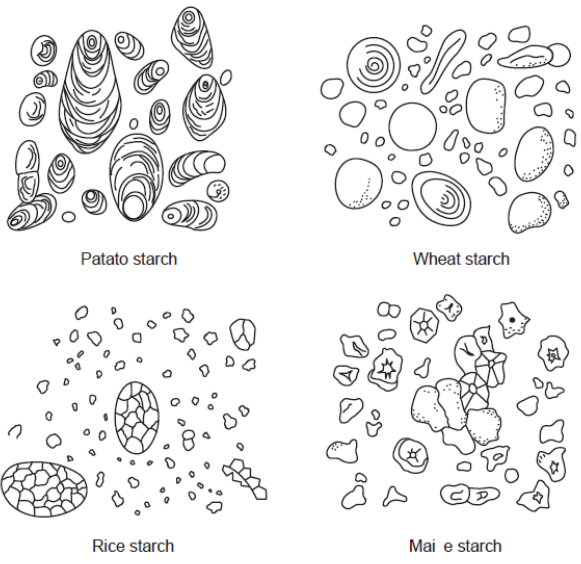
Starch is present in the different parts of the plant in the form of granules of varying sizes. Chemically starches are polysaccharides containing amylopectin and -amylose. Starches are more abundant in:
- fruit,
- seed,
- root,
- rhizome, and
- as smaller grains in chlorophyll in leaves.
Starches of different origins can be identified by studying their:
- size,
- shape,
- structure, and
- position of the hilum and striations
Starches are also known to turn from blue to violet when treated with iodine solution.
Systematic Description of Starch Grain
| Characteristic | Maize | Rice | Wheat | Potato |
|---|---|---|---|---|
| Colour | White | White | Faint grey | Yellowish tint |
| Shape | Simple grains, angular, hilum, central, rarely compound grains. | Simple or compound grains ( components), polyhedral with sharp angles. | Mostly simple (large and small) grains, faint striations, hilum appears as line. | Flattened ovoid or sub-spherical, well-marked striations, hilum eccentric. |
| Size () | Small ; Large | |||
| pH | Neutral | Alkaline | Acidic | Acidic |
| Moisture content () | ||||
| Ash content () |
A systematic description of starches should include
- Shape
- ovoid,
- spherical,
- sub-spherical,
- ellipsoidal,
- polyhedral, etc.
- Size
- Dimensions in .
- Position of hilum
- central,
- eccentric,
- pointed,
- radiate,
- linear, and etc.
- Aggregation
- simple,
- compound
- number of components present in a compound grain
- Appearance between crossed polaroid
- Location
- loose,
- present in type of cell and tissue
- Frequency
- occasional,
- frequent,
- abundant
Aleurone Grain
Aleurone grains are proteins stored by plants that consists of a mass of protein surrounded by a thin membrane and is commonly in the endosperm of the seed.
The ground mass of protein, however, often encloses an angular body (crystalloid) arid one or more rounded bodies (globoids)
Defat thin sections containing aleurone grains and treat with the following reagents:
- Alcohol picric acid
- Ground tissue and crystalloid are stained yellow.
- Millon’s reagent
- Protein is stained red on warming.
- Iodine solution
- Only crystalloid and ground substance are stained yellowish brown.
Calcium Oxalate Crystals
These are considered excretory products of plant metabolism. They occur in different forms and provide valuable information for identification of crude drugs in entire and powdered forms.
- Microsphenoidal or sandy crystals
- belladonna
- Single acicular crystals
- cinnamon,
- gentian
- Prismatic crystals
- quassia,
- hyoscyamus,
- senns,
- rauwolfia,
- cascara
- Rosette crystals
- stramonium,
- senna,
- cascara,
- rhubarb
- Bundles of acicular crystals
- squill,
- ipecacuanha
The secretions to be examined for calcium oxalate should first be cleared with caustic alkali or chloral hydrate. These reagents very slowly dissolve the crystals, so the observation should be made immediately after clearing the section. The polarizing microscope is useful in the detection of small crystals.
Mount the cleared section or powder and observe the reagents.
- Acetic acid
- Insoluble
- Caustic alkali
- Insoluble
- Hydrochloric acid
- Soluble
- Sulphuric acid ()
- Soluble, on standing replaced by needles of calcium sulphate
Calcium Carbonate
Aggregates of crystals of calcium carbonate are called cystoliths, which appear like small bunches of grape in the tissue. Calcium carbonate dissolved with bubbles in acetic, hydrochloric, or sulphuric acid.
When treated with sulphuric acid, needle shaped crystals of calcium sulphate slowly separate out.
Fixed Oils and Fats
Fixed oils and fats are widely distributed in both vegetables and reproductive parts of a plant. They are more concentrated in the seeds as reserved lipid.
Fixed oils occur as small refractive globules, usually in association aleurone grains. They respond to the following tests:
- They are generally soluble in ether and alcohol with some exceptions.
- solution of osmic acid colors them brown or black.
- Dilute tincture of alkanna stains them red on standing for about 30 minutes.
- A mixture of equal parts of strong solution of ammonia and saturated solution of potash slowly saponifies fixed oil and fat.
Mucilage
Mucilages are polysaccharide complexes of sugar and uronic acids, formed from the cell walls.
They are usually insoluble in alcohol but swell or dissolve in water. The following tests are useful for the detection of mucilage in cells.
- Solution of ruthenium red stains the mucilage pink. Lead acetate solution is added to prevent undue swelling of solution of the substance being tested.
- Solution of corallin soda and sodium bicarbonate solution (alkaline solution of corallin) stain the mucilage pink.